Steel Structure Construction
Precision Constructions
Bangalore
7 min read
The Brief: End-to-End, No Handoffs
Building a warehouse, industrial plant, or commercial complex is a massive financial commitment. The structural integrity of that facility relies heavily on a single material: steel. However, not all steel is manufactured equal. Choosing substandard material can lead to structural sagging, weld failures, or severe corrosion over time.
For businesses looking to build durable facilities, understanding how to source and evaluate structural steel is the first step toward project success. If you are collaborating with top structural engineering firms in Bangalore like Precision Constructions, they will invariably emphasize that material grading and certified fabrication are non-negotiable for project longevity.
Focus on chemical composition and structural grades
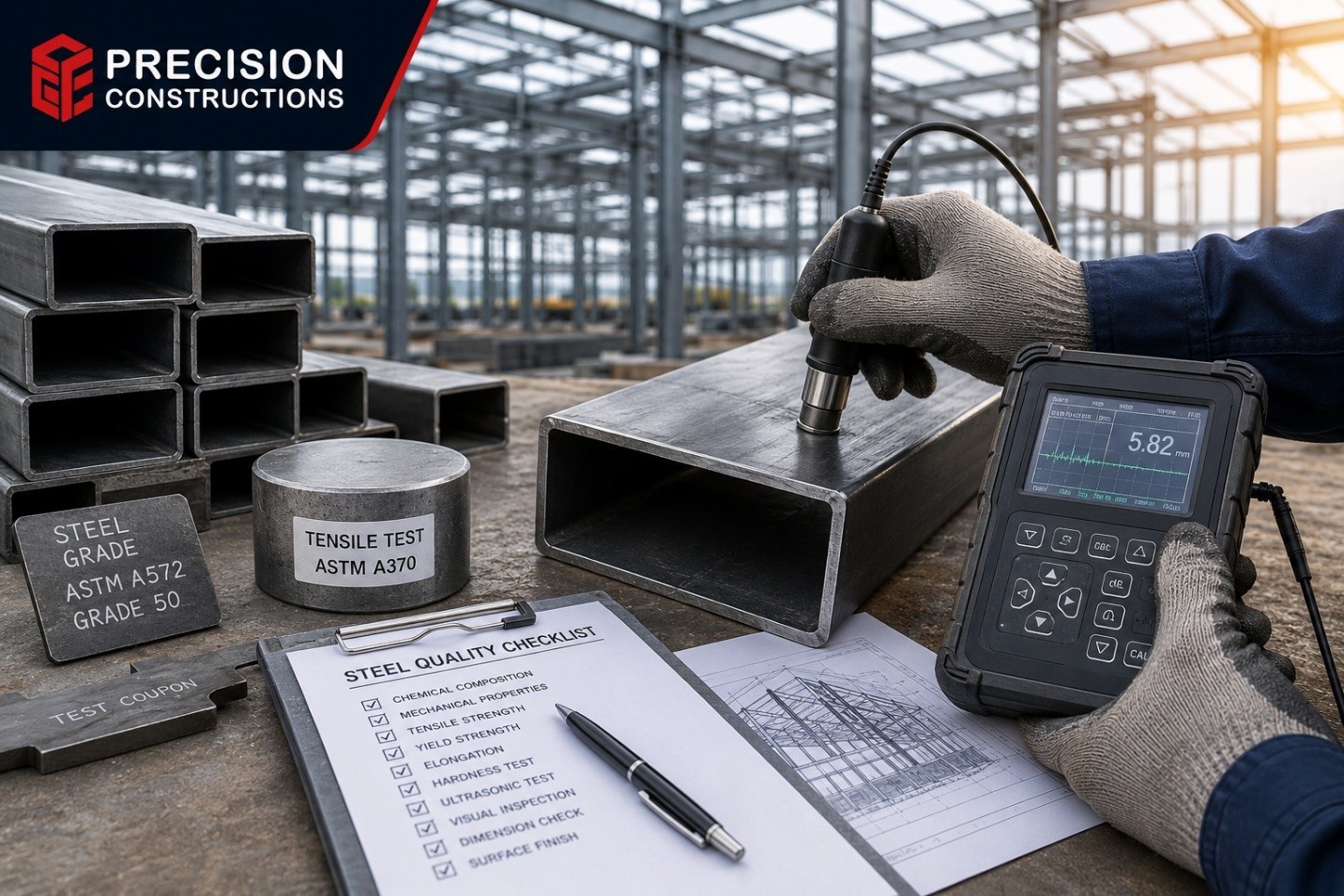
The load-bearing capacity of your building depends entirely on the grade of steel you select. In structural steel fabrication, mild steel grades are evaluated based on their yield strength (the amount of stress the material can handle before permanently deforming).
The industry standards for high-quality industrial and commercial projects rely on specific grades:
IS 2062 (Grade E250 / E350)
This is the standard Indian benchmark for structural steel. It ensures excellent weldability and high tensile strength.
ASTM A36 / A572
These are internationally recognized standards for carbon structural steel shapes, plates, and bars used in heavy construction.
2. VERIFY MATERIAL TEST CERTIFICATES (MTC)
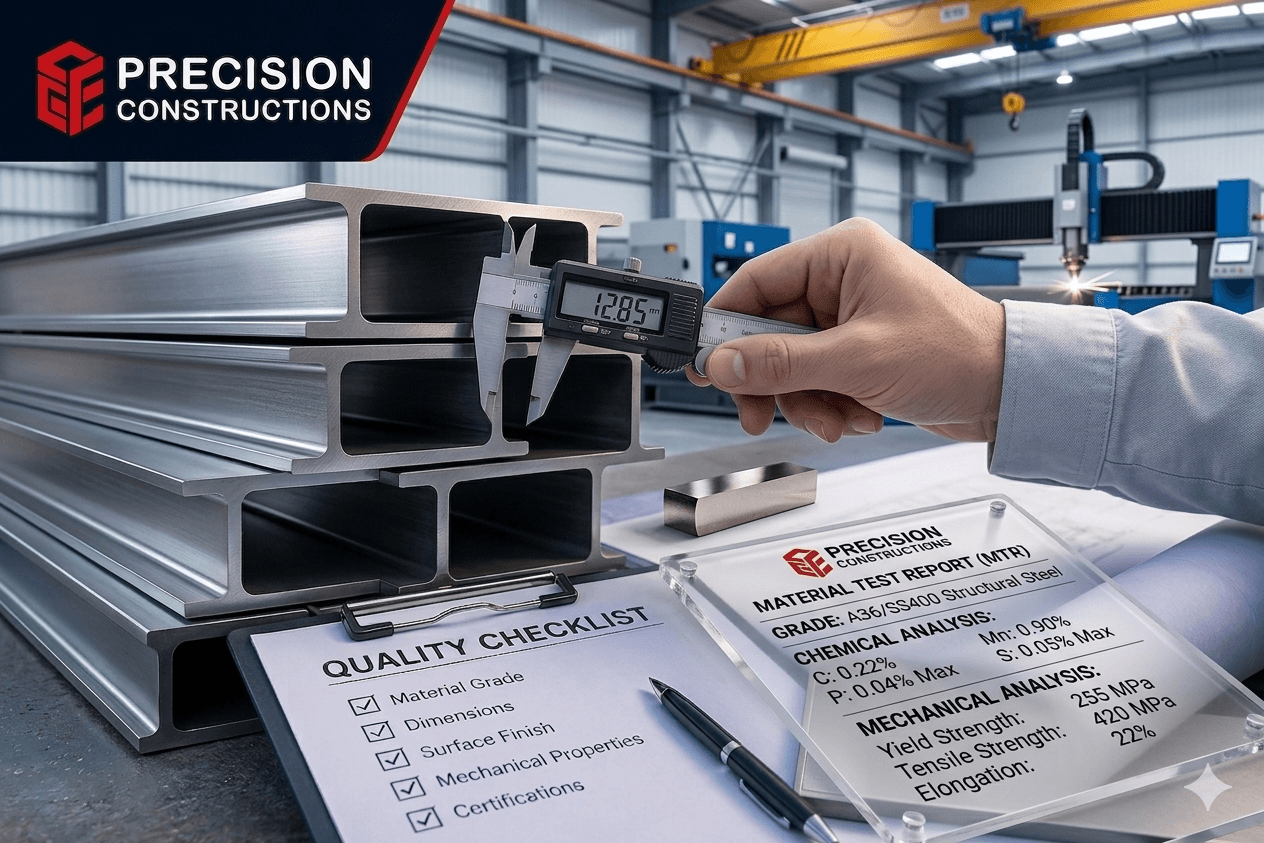
Never accept steel structural components without a verified Material Test Certificate (MTC) provided by the manufacturer. An authentic MTC acts as the birth certificate of your steel batch, validating its chemical composition, tensile strength, yield strength, and elongation properties.
Reputable construction partners like Precision Constructions ensure that every structural section—whether it is an H-beam, I-beam, or hollow section—is fully traceable back to primary steel producers like JSW, Tata, or SAIL. This level of transparency guarantees that your project complies with global safety protocols.
3. Evaluate fabrication and corrosion resistance
Raw steel is only half the battle; how it is fabricated determines its performance on-site. When managing large-scale industrial projects, working with an experienced partner handles the complexities of pre-engineered building (PEB) design and heavy structural fabrication.
Furthermore, you must consider environmental factors. To prevent rust and environmental degradation, ensure your structural components undergo advanced surface treatments:
Hot-Dip Galvanizing
This process involves coating the steel with a thick layer of molten zinc. It is best used for highly corrosive or outdoor environments to prevent long-term rust.
Epoxy Primer Coating
This involves applying chemical-resistant liquid primers. It is highly effective for industrial indoor plants and warehouses that need protection from chemical moisture.
Check dimensional accuracy and ISO standards
Structural steel must be perfectly straight and manufactured to exact dimensional tolerances. Even a deviation of a few millimeters in a steel column can alter the load distribution of the entire roof grid, causing structural imbalances. Partnering with professionals who specialize in steel structure construction Bangalore like Precision Constructions guarantees that your components are manufactured in ISO-certified facilities under strict quality controls, preventing costly alignment issues during on-site erection.
When structural components are engineered to precise specifications, it drastically speeds up the on-site assembly process, cutting down labor hours and lowering total project overheads.